Exhibitions Organized at the Ackland Art Museum University of North Carolina at Chapel Hill, NC 1996 – 2009
Circles of Divinity: Cross Cultural Connections, 1997
Deepak Joshi, Design for an Environmental Nag Panchami Poster, 1993, tempera on paper. Conceived for the ecological art installation, The Myth of the Nagas and the Kathmandu Valley Watershed, by Jyoti Duwadi and Barbara Matilsky
This exhibition, mostly drawn from the Ackland’s permanent collection, spanned five continents and four thousand years. The circle and spiral — forms embedded in the natural world — appear in all spiritual traditions. Representing the continuity of life and the promise of rebirth, they have become universal symbols. Circles of Divinity was organized to underscore the common bonds that link the human species and suggest the possibility of peace within oneself and between people.
Indian, Gujarat, Siddhachakra (Circle of Liberators), c. 1500, ink and opaque watercolor on sized fabric, Ackland Art Museum, Gift of Clara and Gilbert Yager
Identity Revealed: Meaning and Message in Contemporary Art, 1998
Danny Lyon, Crossing the Ohio, Louisville, 1966, gelatin silver print
Organized on the eve of the new millennium, this exhibition surveyed how artists responded to the unprecedented social changes initiated since the 1960s. From the birth of a new environmental consciousness to the celebration of ethnic diversity, American culture experienced a rapid process of transformation. Identity Revealed examined the artists’ search to understand and find meaning in the radically shifting relationships among people, culture, and nature. Drawn primarily from the Ackland Art Museum’s collection, it included works by Karel Appel, Lothar Baumgarten, Tseng Kwong Chi, Chuck Close, Jim Dine, Rimma Gerlovina & Valeriy Gerlovin, Nan Goldin, Jasper Johns, Duane Michaels, Robert Morris, Elizabeth Murray, Bruce Nauman, Robert Rauschenberg, Larry Rivers, Joan Snyder, Renée Stout, Kara Walker and Andy Warhol, among others.
Rimma Gerlovina & Valeriy Gerlovin, Tree of Life, 1989, Ektacolor photograph and metal frame, Ackland Art Museum Collection
The Spirit of Place: Art, Environment, Community, 1998
Ritsuko Taho, 3D model of proposal for Ackland Art Museum facade, 1998
Patrick Dougherty, High Strung, 1998, gum, maple and dogwood tree branches and twigs, sculpture installation for the museum entrance
To celebrate the Ackland’s 40th anniversary, five artists were invited to visit Chapel Hill and then submit proposals for a site-integrated environmental artwork to transform the museum entry area. The project offered artists an opportunity to create a highly visible public space in the heart of Chapel Hill. We welcomed a variety of approaches to design and selected a group of artists whose works were visually and conceptually diverse. An exhibition featured models and drawings by artists Elizabeth Conner, Adam Kuby, Andrew Leicester, Winifred Lutz, and Ritsuko Taho. The museum also commissioned a temporary outdoor installation by Patrick Dougherty to highlight the site.
Rendezvous North Carolina: Twentieth-Century Sculpture and Sculptors’ Drawings from the Collections of the Ackland Art Museum and the Weatherspoon Art Museum, University of North Carolina, Greensboro, 1999
Exhibition installation at the Ackland Art Museum
This collection-sharing collaboration featured the most prominent sculptures in two of North Carolina’s flagship university art museums. It highlighted 35 sculptures and 25 drawings by artists who helped revitalize and transform sculpture during the 20th century, including Hans Arp, Anthony Caro, Eva Hesse, Sol LeWitt, Richard Long, Auguste Rodin, Joyce Scott, Richard Serra, George Segal, David Smith, Robert Smithson, among others.
Although the human figure continued to offer sculptors inspiration for innovative interpretations, its dominance was shaken by the desire to use unconventional materials and techniques to translate a myriad of new ideas and themes. The emphasis on solidity and mass that defined traditional sculptures through the ages was replaced by open, spatial compositions that soon gave way to the dematerialization of the art object altogether.
George Segal, Girl Resting, 1970, plaster and gauze, Ackland Art Museum collection
From the Molecular to the Galactic: The Art of Max Ernst and Alfonso Ossorio, 2000
Max Ernst, Design in Nature, 1947, oil on canvas, The Menil Collection, Houston
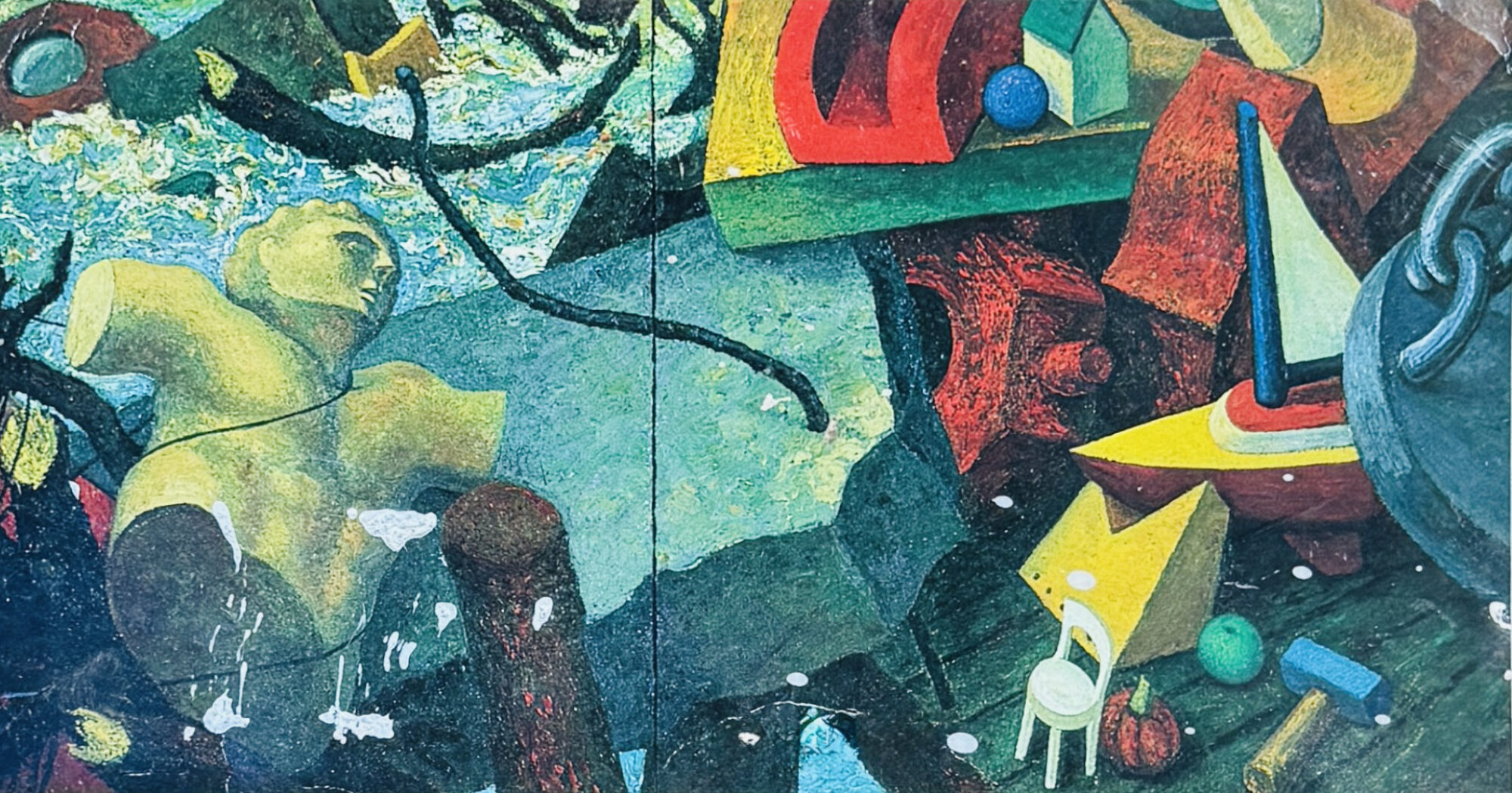
Image-Alfonso Ossorio, Breaking Chain, 1963, mixed media, 32x33x4 in., Ackland Art Museum Collection
The idea for this exhibition evolved after viewing the collection of books and prints by Max Ernst owned by Dr. William and Phyllis Koehnline and making a visit to the Ossorio Foundation in Southampton, New York. Although stylistically distinct, the two artists shared a love of nature and were inspired by biology, geology, and astronomy. Innovative materials, media, and techniques also distinguish their works that often appear hallucinatory and surreal. The exhibition catalogue was written by art history graduate students Jessica Dallow and Colleen Thomas.
Illuminations: Contemporary Film and Video Art, 2000
Nam June Paik, Eagle Eye, 1996, antique slide projector, aluminum, nine computer keyboards, eye chart, neon, eleven televisions, 67x81x24.5 in. 7 minutes
Illuminations was conceived as an introduction to time-based media and featured internationally recognized artists Jim Campbell, William Kentridge, Mariko Mori, Pepón Osorio, Tony Oursler, Nam June Paik, and Peter Sarkisian. The works selected offered viewers the opportunity to experience diverse styles and approaches to the medium. Artists interpreted social, political, psychological and spiritual themes often through hauntingly beautiful imagery.
The exhibition was a collaboration with David C. Hart, a curatorial intern and graduate art history student. It was funded by the North Carolina Arts Council.
Peter Sarkisian, Hover, 1999, mixed media and video projection, 35x35x30 in. 11:30 minutes
Buddhist Art and Ritual from Nepal and Tibet, 2002-2004
View of Buddhist Altar.
This exhibition highlighted the way art functions within the spiritual perspective of a traditional Tantric Buddhist altar. It conveyed the integration of art and ritual that is fundamental to understanding the meaning of these objects within living cultural traditions. For this two-year exhibition period, the Ackland Art Museum presented paintings, sculptures and other sacred objects borrowed from the Los Angeles County Museum of Art, The Newark Museum, and the Rose Art Museum at Brandeis University.
The Venerable Tenzing Gopher, from the Namyglay Monastery in Ithaca New York, was invited to place the works within their appropriate alter setting. This installation was further brought to life by three Namgyal monks during their three-and-a-half week construction of a Medicine Buddha sand mandala in the gallery.
Buddhist Art and Ritual from Nepal and Tibet was curated in collaboration with former museum educator Ray Williams. The artist Jyoti Duwadi contributed a video, filmed in Nepal, that conveyed the exhibition’s theme.
Defining Moments: Two Centuries of Photography, 2003
Featuring 90 images drawn from the Ackland Art Museum’s extensive photography collection, the exhibition offered a survey of the medium through themes of landscape, nature close-up, architecture, shapes of industry, the city, social documentary, portraits and travel. Defining Moments also presented photographic processes highlighting the variety of ways images have been created, beginning with the daguerreotype.
Anna Atkins, Lastroea Oreopteris, c. 1851-1854, cyanotype, 18 x 14 in., Ackland Art Museum Collection
Edward Burtynsky, Rock of Ages, #14, Abandoned Granite Section, E.I. Smith Quarry, Bare, Vermont, 1992, chromogenic print, Ackland Art Museum
The exhibition traveled to York College Galleries, York, Pennsylvania in 2006. The show was a collaboration with Cathy Keller-Brown, assistant curator of exhibitions. Defining Moments was curated in conjunction with the exhibition, Collecting Photography: A Community Dialogue in 2003.
Five Artists-Five Faiths: Spirituality in Contemporary Art, 2004-2005
Ahmed Mustafa, Where the Two Oceans Meet (Third Statement), 2001, oil and watercolor on paper, 73 3/4 x 88 3/4 in
Helene Aylon, The Liberation of G-d, 1990-96, multi-media installation with video, dimensions variable, The Jewish Museum, New York
This exhibition, highlighting the museum’s Five Faith’s project, presented the works of five artists who interpret the philosophies and artistic traditions of Buddhism, Christianity, Islam, and Judaism. Although each work was unique, points of connection converged in references to light, geometry, meditation, and the non-duality of life.
The exhibition included Helene Aylon’s multi-media video installation, The Liberation of G-d, that presents an alternative interpretation of the Torah by highlighting between words where a female presence is omitted and over words that describe cruelty to animals and militarism.
Kimsooja’s video projection, A Laundry Woman: Yamuna River, India, suggests the importance of meditation and invites viewers to vicariously experience contemplating the cycles of life and connections to nature. Ahmed Moustafa’s oil and watercolor drawings and steel, plexiglas light sculpture reference the Qur’an, Islam’s sacred text.
Kimsooja, A Laundry Woman, Yamuna River, India, 2000, color video projection, 10:30 minutes
Pamela Singh, Tantric Self-Portait in Jaipur #1, 2000-2001, black and white photograph, oil, acrylic, gold, mud, and vermillion powder, 37 x 37 in., Ackland Art Museum collection
Stephen Antonakis, Saints Peter and Paul, 2003, gold leaf on versacel, neon, 41 1/2 x 30 x 4 1/4 in. One of three panels installed in the Meditation Chapel of Saints Peter and Paul, 2004, 16x20 ft.
Pamela Singh’s photographs evoke a mystical form of Hinduism known as Tantra, a belief in powerful universal energies permeating and unifying all things. Stephen Antonakis’ site-specific installation, Meditation Chapel of Saints Peter and Paul highlighting three neon panels, was commissioned by the museum and provided a place for people to sit and find peace.
This exhibition was funded by the National Endowment for the Arts and the Henry Luce Foundation.
Family Legacies: The Art of Betye, Lezley and Alison Saar, 2005
Partial exhibition view of Family Legacies at the Ackland Art Museum
Family Legacies was the first exhibition to celebrate the art of Betye, Lezley and Alison Saar. It was organized with the following themes in mind: Spirituality; African and African American Culture; Explorations of Ancestry and Personal Identity; Interpretations of Historical and Contemporary Images of African Americans. The Ackland purchased one work by each of the artists after the exhibition.
Co-curated by Jessica Dallow whose doctoral dissertation from the University of North Carolina, Chapel Hill focused on Family Legacies: Race, Gender and Inheritance in the Art of Betye and Alison Saar. This exhibition traveled to the Pasadena Museum of Contemporary Art, CA; The San Jose Museum of Art, CA; and the Palmer Museum of Art, Pennsylvania State University. Funded by major grants from the National Endowment for the Arts and Altria Group, Inc.
Betye Saar, Black Girl’s Window, 1969, mixed media assemblage, 35 1/4x18x1 1/2 in
Alison Saar, Inheritance, 2003, wood, ceiling tin and cotton 72x29x29 in
Lezley Saar, Ascension of a Lily Skin, 1997, acrylic and mixed media, 86x40x5 in
Up Close and Personal: Portraits of the Artist, 2006
Chuck Close, Lyle, 2003, 149 color silkscreen, Ackland Art Museum collection
Red Grooms, Untitled (Mimi in Provincetown), 1970, crayon and gouache on paper, 35x23 in., Ackland Art Museum collection
This exhibition, featuring 75 works of art in all media drawn from the Ackland Collection and spanning two hundred years, suggested the myriad ways that artists view and interpret their unique status in society: the artist as heroic genius; the artist outside the margins of society; the artist as social commentator; and the artist as the embodiment of spirituality, were some of the themes outlined in the show. Views of artist’s studios and teaching spaces were also included. The exhibition showed correspondences between different time periods, underlining some of the changing attitudes of artists towards a life in the arts.
Depth of Field: Expanding Perspectives in 20th Century and Contemporary Photography, 2006
Richard Misrach, Submerged Gazebo, Salton Sea, California (detail), 1984, printed 1997, chromogenic (Type-C) print, Ackland Art Museum Collection
Eight American photographers who made important contributions to the field in the mid-twentieth century were each represented by ten photographs covering their career or representing a single project. To further explore differences and similarities, these works were also paired with one photograph by a more contemporary artist that extends their visions.
This exhibition featured works from the Ackland Collection by Berenice Abbott, Robert Adams, Marco Breuer, Carl Chiarenza, Robert Frank, Richard Misrach, Julie Moos, Aaron Siskind, Gary Schneider, Minor White, Garry Winogrand, among others.
Curated by Barbara Matilsky and Timothy Riggs, Curator of Drawings
Berenice Abbot, “Canyon,” Broadway and Exchange Place, 1936, gelatin silver print. Commissioned by Federal Art Works Progress Administration. Lent by the U.S. General Services Administration, Fine Arts Collection
In and Around the Garden: Perspectives East and West, 2008
Chiho Aoshima, City Glow, 2005, lithograph, Ackland Art Museum
This exhibition explored the connection between peoples around the world and their gardens. Cultivating the earth is an aspect of human activity that transcends nationality and ideology. In many Asian, European, and American cultures, gardens are created in response to both physical and emotional needs. They are sources of sustenance but also of beauty, becoming sites for pleasure, love, and spiritual fulfillment.
By juxtaposing works of art from a broad range of geographic regions and time periods, In and Around the Garden suggested that common threads binding cultures together as well as their unique styles in representing gardens over centuries. Works were presented from the collection along with loans from private collectors and artists, including Catherine Chalmer’s video, Safari.
Collecting Contemporary Art A Community Dialogue, 2001
Collecting Photography A Community Dialogue, 2003
Collecting Contemporary Prints A Community Dialogue, 2005
Hung Liu, Peaches, 2002, oil on canvas, Ackland Art Museum Collection
Gordon Parks, Malcolm X and the Black Muslims, 1963, printed 1977, Ackland Art Museum Collection
Barbara Takenaga, Shaker Blue (detail), 2004, color lithograph, silkscreen and hand coloring, Ackland Art Museum Collection
Three collecting exhibitions were organized by medium. Works of art were selected and presented to staff for discussion. Those approved were exhibited for public review and comment regarding which pieces should be purchased. Art in all media were loaned from New York, Chicago, and Los Angeles art galleries.
Artworks selected for consideration either complemented specific pieces in the collection, referenced art history and cultures represented in the museum, built on important directions in modern and contemporary art, or could be exhibited as a center piece in the Lobby Gallery.